One call must mean one call.
The historical reduction printed CALLED three times versus once for a bound result. Finalc14 inline and bound reductions both execute exactly once. The original diagnostic is retained; it is not a current defect.
EXPERIMENT 08 / FILESYSTEM AUTOMATION
A project tree under inspection.
Five runtimes. One verified filesystem.
Nift completes the work.
Bulk checksum and mirror throughput still lag.
f000000.mdGENERATE
f000001.jsonINSPECT
f000004.datCOPY
Nift 4.12.0 final candidate · Python 3.15.0 · Node 24.21.0 · Bun 1.4.3 · Go 1.27.2
project/walk/A directory walk becomes a runtime workload long before it becomes a bandwidth test.
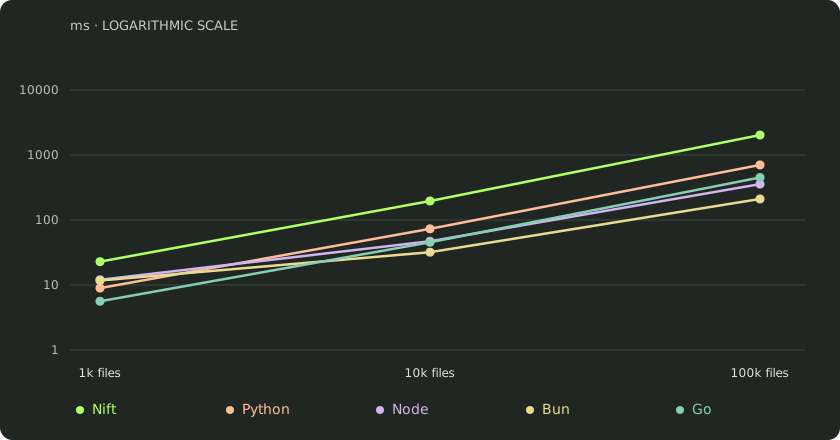
| Workload | Nift | Python | Node | Bun | Go |
|---|---|---|---|---|---|
| 1k files | 22.877 | 8.966 | 12.035 | 11.726 | 5.619 |
| 10k files | 196.061 | 73.194 | 47.143 | 31.965 | 45.458 |
| 100k files | 2,029.268 | 703.614 | 356.774 | 210.880 | 451.046 |
Exact values above. On small screens, scroll the table independently →
project/inspect/Type-only checks acquire size metadata too. The explicit stat workload adds two queries per file.
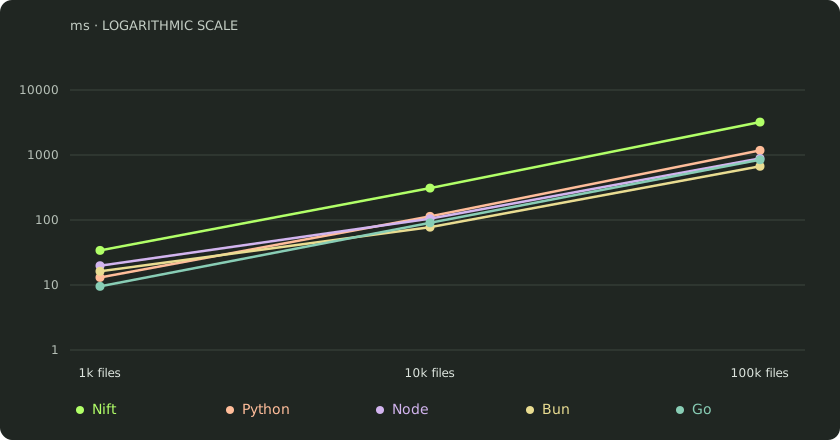
| Workload | Nift | Python | Node | Bun | Go |
|---|---|---|---|---|---|
| 1k files | 34.056 | 13.063 | 19.813 | 16.265 | 9.538 |
| 10k files | 309.684 | 113.802 | 104.888 | 77.531 | 90.535 |
| 100k files | 3,210.583 | 1,177.859 | 886.655 | 670.540 | 845.759 |
Exact values above. On small screens, scroll the table independently →
Historical20261011 traced requests, not final-candidate counts; linear zero-origin counts. Counts include directory/runtime work. Only four readlinks per trace. Syscall counts do not explain all wall time.
project/select/Every filter stats every file before selection. Selection percentages describe results, not avoided metadata work.
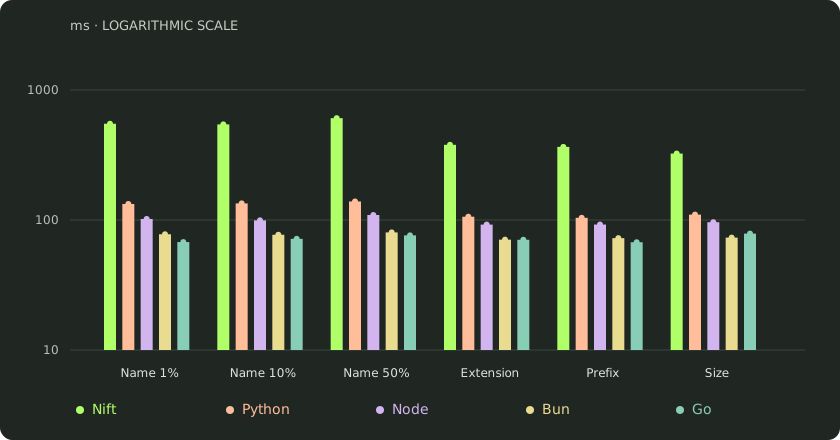
| Workload | Nift | Python | Node | Bun | Go |
|---|---|---|---|---|---|
| Name 1% | 550.021 | 132.821 | 101.850 | 77.676 | 67.646 |
| Name 10% | 543.735 | 134.178 | 99.377 | 76.986 | 71.627 |
| Name 50% | 607.154 | 138.870 | 109.221 | 80.265 | 76.184 |
| Extension | 378.766 | 105.971 | 92.159 | 70.592 | 70.459 |
| Prefix | 365.017 | 103.940 | 92.260 | 72.501 | 67.436 |
| Size | 324.383 | 110.011 | 96.160 | 73.193 | 78.562 |
Exact values above. On small screens, scroll the table independently →
project/read/The checksum visits every byte in the language. Large-file reads load the full payload but aggregate endpoints only.
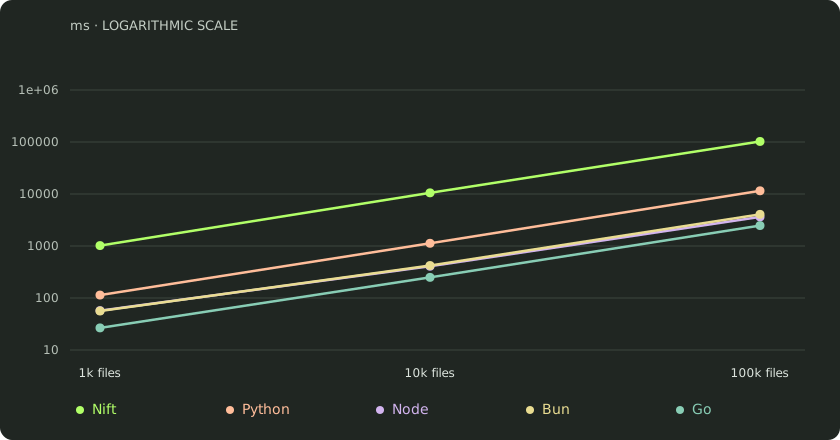
| Workload | Nift | Python | Node | Bun | Go |
|---|---|---|---|---|---|
| 1k files | 1,019.024 | 113.848 | 57.197 | 56.240 | 26.617 |
| 10k files | 10,530.112 | 1,127.583 | 408.164 | 421.197 | 249.394 |
| 100k files | 102,441.259 | 11,525.007 | 3,627.604 | 4,062.430 | 2,472.142 |
Exact values above. On small screens, scroll the table independently →
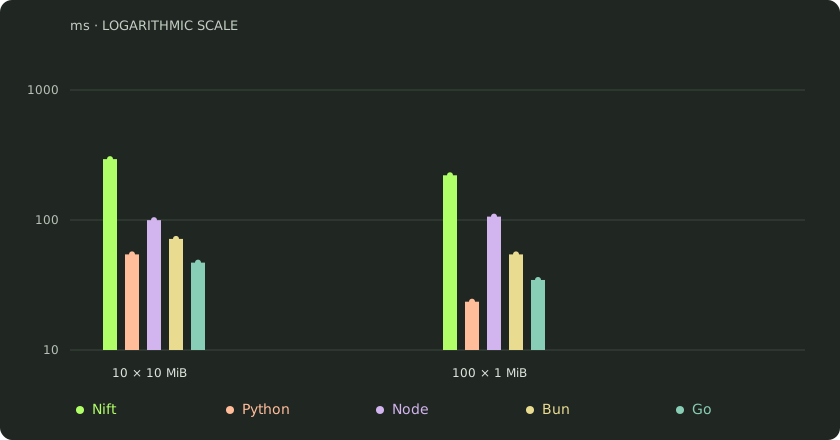
| Workload | Nift | Python | Node | Bun | Go |
|---|---|---|---|---|---|
| 10 × 10 MiB | 293.858 | 54.389 | 99.725 | 71.541 | 46.997 |
| 100 × 1 MiB | 220.743 | 23.525 | 106.170 | 54.369 | 34.573 |
Exact values above. On small screens, scroll the table independently →
project/fingerprint/Native SHA-256 is unavailable in this Nift snapshot. The portable checksum cannot substitute for a cryptographic release manifest.
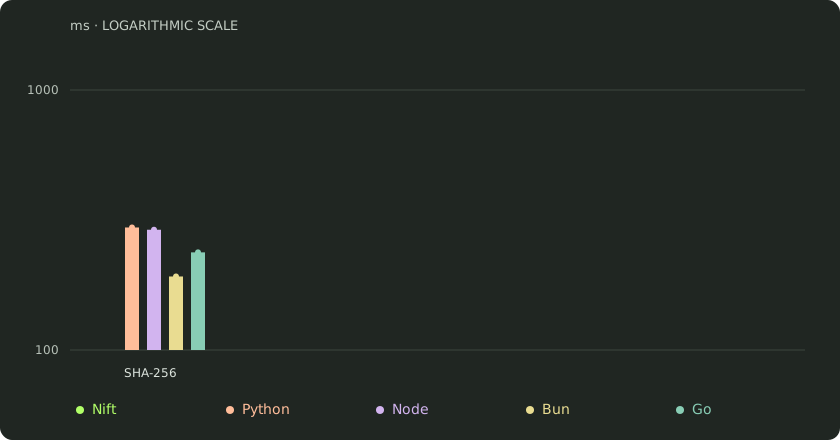
| Workload | Nift | Python | Node | Bun | Go |
|---|---|---|---|---|---|
| SHA-256 | — | 295.954 | 290.092 | 191.766 | 237.422 |
Exact values above. On small screens, scroll the table independently →
project/write/Stream writes include source reads; copies verify bytes and paths, not permissions or metadata.
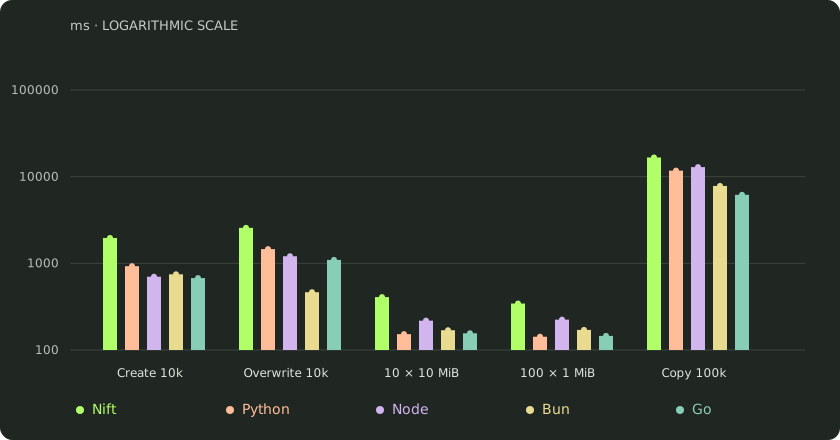
| Workload | Nift | Python | Node | Bun | Go |
|---|---|---|---|---|---|
| Create 10k | 1,961.167 | 927.347 | 701.237 | 747.142 | 675.893 |
| Overwrite 10k | 2,567.117 | 1,459.327 | 1,207.568 | 464.282 | 1,095.094 |
| 10 × 10 MiB | 407.801 | 152.489 | 218.158 | 169.130 | 155.823 |
| 100 × 1 MiB | 343.660 | 142.333 | 223.981 | 170.532 | 145.462 |
| Copy 100k | 16,647.781 | 11,739.109 | 12,887.422 | 7,814.195 | 6,175.213 |
Exact values above. On small screens, scroll the table independently →
project/mirror/Both trees are fingerprinted. Identical destination files retain their timestamps.
  keep.md unchanged
~ edit.md new bytes
+ add.dat new path keep.md preserve mtime
~ edit.md replace bytes
+ add.dat copy
- old.dat remove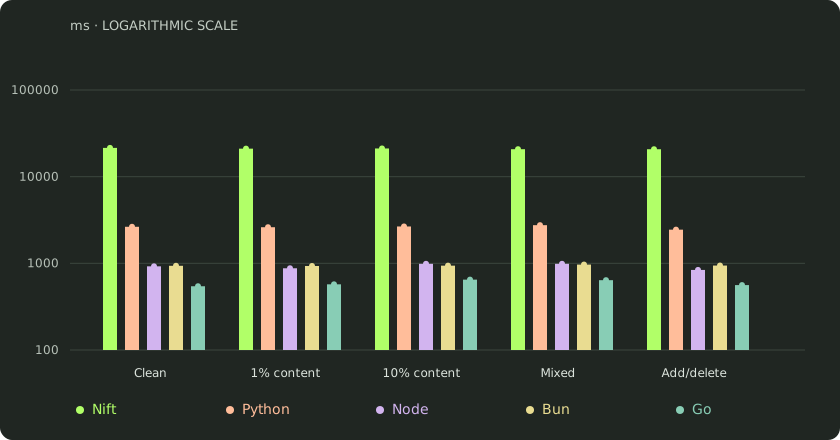
| Workload | Nift | Python | Node | Bun | Go |
|---|---|---|---|---|---|
| Clean | 21,479.644 | 2,640.587 | 923.544 | 936.652 | 543.993 |
| 1% content | 21,048.003 | 2,609.835 | 876.791 | 932.018 | 572.536 |
| 10% content | 21,153.051 | 2,662.650 | 987.168 | 940.122 | 648.510 |
| Mixed | 20,744.535 | 2,756.055 | 987.482 | 967.749 | 639.076 |
| Add/delete | 20,726.105 | 2,446.563 | 839.236 | 942.746 | 560.993 |
Exact values above. On small screens, scroll the table independently →
project/changes/Modification-time access is unavailable in this Nift snapshot. Content and timestamp detection intentionally answer different questions.
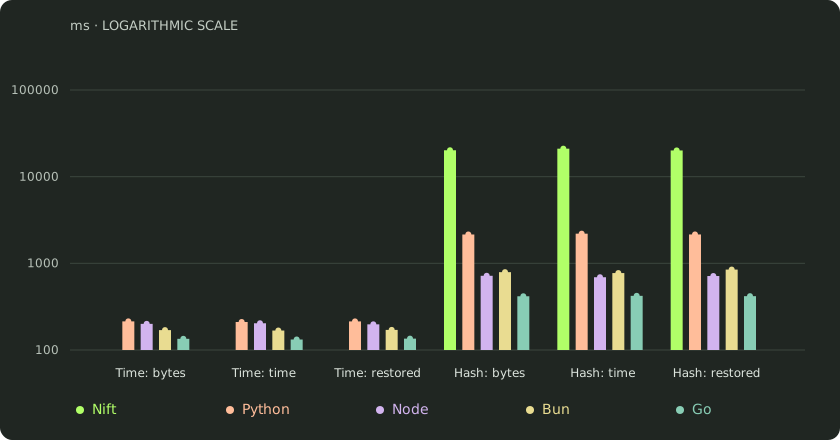
| Workload | Nift | Python | Node | Bun | Go |
|---|---|---|---|---|---|
| Time: bytes | — | 213.947 | 200.263 | 169.598 | 134.602 |
| Time: time | — | 210.445 | 203.443 | 167.721 | 132.169 |
| Time: restored | — | 213.778 | 197.703 | 170.574 | 135.238 |
| Hash: bytes | 20,165.358 | 2,151.856 | 718.198 | 791.047 | 416.777 |
| Hash: time | 21,031.620 | 2,198.582 | 691.207 | 772.116 | 421.593 |
| Hash: restored | 20,065.571 | 2,154.094 | 713.792 | 847.003 | 417.963 |
Exact values above. On small screens, scroll the table independently →
project/pipeline/Generate documents, copy selected assets and produce a sorted manifest. This is controlled project automation, not a website build.
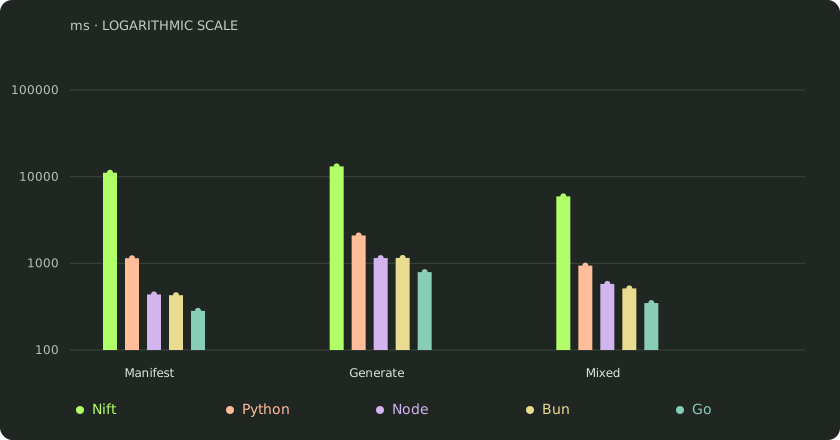
| Workload | Nift | Python | Node | Bun | Go |
|---|---|---|---|---|---|
| Manifest | 11,105.603 | 1,144.951 | 437.788 | 428.656 | 283.115 |
| Generate | 13,139.376 | 2,095.683 | 1,150.373 | 1,154.427 | 791.976 |
| Mixed | 5,921.117 | 940.791 | 578.602 | 513.347 | 348.163 |
Exact values above. On small screens, scroll the table independently →
project/memory/Fifteen final-candidate post-exec observations use the original verified walk protocol on a separate four-vCPU / 8 GiB Ubuntu 24.04 Linode of the same plan. Each runtime/size has one observation; these are checkpoints, not a distribution or significance claim.
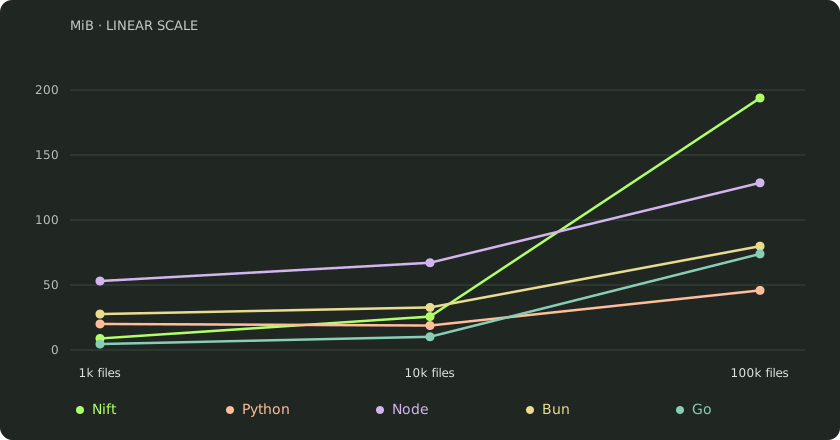
| Workload | Nift | Python | Node | Bun | Go |
|---|---|---|---|---|---|
| 1k files | 8.875 | 20.039 | 53.055 | 27.648 | 4.582 |
| 10k files | 25.727 | 18.816 | 67.129 | 32.750 | 10.180 |
| 100k files | 193.848 | 45.871 | 128.609 | 79.875 | 73.910 |
Exact values above. On small screens, scroll the table independently →
The separate final noop-child control rose from16.75 to80.75 MiB when its parent allocated64MiB; that confirms why launch-inclusive wait4 accounting is not substituted for these post-exec checkpoints. The fifteen new values use the frozen accepted protocol and pinned peers; no constant has been subtracted.
project/diagnostics/Historical20261011 profiles and metadata traces below are retained analytical leads, not new final profiles; final exactly-once gates pass.
The historical reduction printed CALLED three times versus once for a bound result. Finalc14 inline and bound reductions both execute exactly once. The original diagnostic is retained; it is not a current defect.
The inspector queries status and file size even for type-only checks. Extra 20,000 stat calls accompany the 10k explicit-stat workload. Preserve races, symlinks and error contracts when consolidating.
The separate 10k stat heaptrack diagnostic records 1,111,623 temporary allocations. String construction and condition trimming are concrete leads; instrumentation changes timing.
Read profiles include AST evaluation, RuntimeValue lifetime, loop dispatch and variable lookup. Bulk reads are far less extreme. This motivates decomposition, not a claim that one function explains the gap.
Template Engines also profiled expression/string/allocation work; Concurrency profiled AST/value handling while demonstrating real multicore scaling. A shared value/execution mechanism is plausible, but their differing paths do not establish a single root cause.
project/practitioner/Usable for bounded Nift-owned automation; large-tree throughput is weak in this snapshot.
Human + agent: Python for new standalone general automation, Go for bulk work, Nift for bounded existing-project operations. Agent-primary: the same conditional choices; explicit ownership/inputs/lifecycle help inspection but autonomous edit/recovery productivity was not measured. For new filesystem or release tooling today, I would choose Python for compact library-driven automation or Go for a maintained standalone utility. Traversal overhead, repeated metadata queries, allocation volume, slow per-byte interpreter work and copy/mirror costs are operational problems. Missing timestamps, native cryptographic hashing and clear recursive cleanup add real contract gaps. Final exactly-once gates pass; side-effect reliability remains essential.
Reusable metadata-bearing directory entries; fewer status/size queries; substantially less path/string/value allocation; faster scalar processing; native SHA-256 and timestamps; safe recursive helpers; continued exactly-once reliability; and competitive large-tree scaling. I would retain explicit roots, artifact ownership, lifecycle and independently checkable outputs.
| Workflow | Today | Mature-Nift counterfactual |
|---|---|---|
| Nift-owned project | Nift for bounded covered operations | Nift: shared policy and lifecycle |
| Agent-authored automation | Python/Go for a new filesystem tool | Nift: programmable explicit contracts, without another executor underneath |
| New release tooling | Python/Go: hashes, timestamps, cleanup | Nift for project-attached release policy; Go for standalone delivery |
| Large tree scanner | Go: throughput and typed metadata/errors | Nift becomes viable if scaling and memory are genuinely competitive |
| Portable standalone utility | Go: compiled binary, no installed script runtime | Still often Go: build/distribute per-platform binaries with embedded dependencies |
Existing Python or JS module requirements remain specific integration reasons to choose those runtimes. This Linux campaign does not certify Windows paths, symlinks or portability. Explicitness is useful only when the runtime reliably enforces it.
project/method/Official timing remains frozen. A separate fifteen-cell final-candidate diagnostic refreshes the original post-exec memory view without changing its protocol.
Fresh four-vCPU / 8 GiB Ubuntu 24.04 Linode; AMD EPYC 7542; affinity 0–3. Four-CPU affinity. 752 cells; 14,264 measured observations + 752 retained warmups; independent exact/reset/distribution audits passed.
Final candidate: c14d06835bca515a5281e41da0e40219c2d60ef0.
Fresh timing includes launch and exit; booted timing begins after readiness and ends at the complete response. Every observation uses a new runtime. Fixtures are restored, fully read and statted outside timing. Runtime order rotates; no outliers are removed. Full result sets/output SHA-256 checks and independent distribution/reset audits pass. Low-count stress tails are descriptive.
Warm Linux filesystem state, ASCII paths, fixed three-level corpus, no symlink/permission/glob or physical-bandwidth claim. Five file sizes (96–2,048 bytes) and extensions correlate with groups. No fsync or global cache dropping. Output serialization is inside timing; canonical oracle sorting is outside (Nift ls itself sorts).
Primary 75e77bb4bb6fb0b8c49920f641c77b394aec5985; supplement 1ab31488eb949eb8f8cd6d50b0eb9fd59e1ad78e; core c14d06835bca515a5281e41da0e40219c2d60ef0. Evidence commit 19e390183b9bcb039abe6aa553ad88a2305b49ee.
All 752 distributions, p95/min/max, commands, source, correctness and implementation boundaries remain in the evidence and full appendix. The launch/lifetime memory accounting limitation is preserved alongside the corrected diagnostic.
Canonical frozen evidence ↗ · Complete distributions ↗ · Core handover ↗